

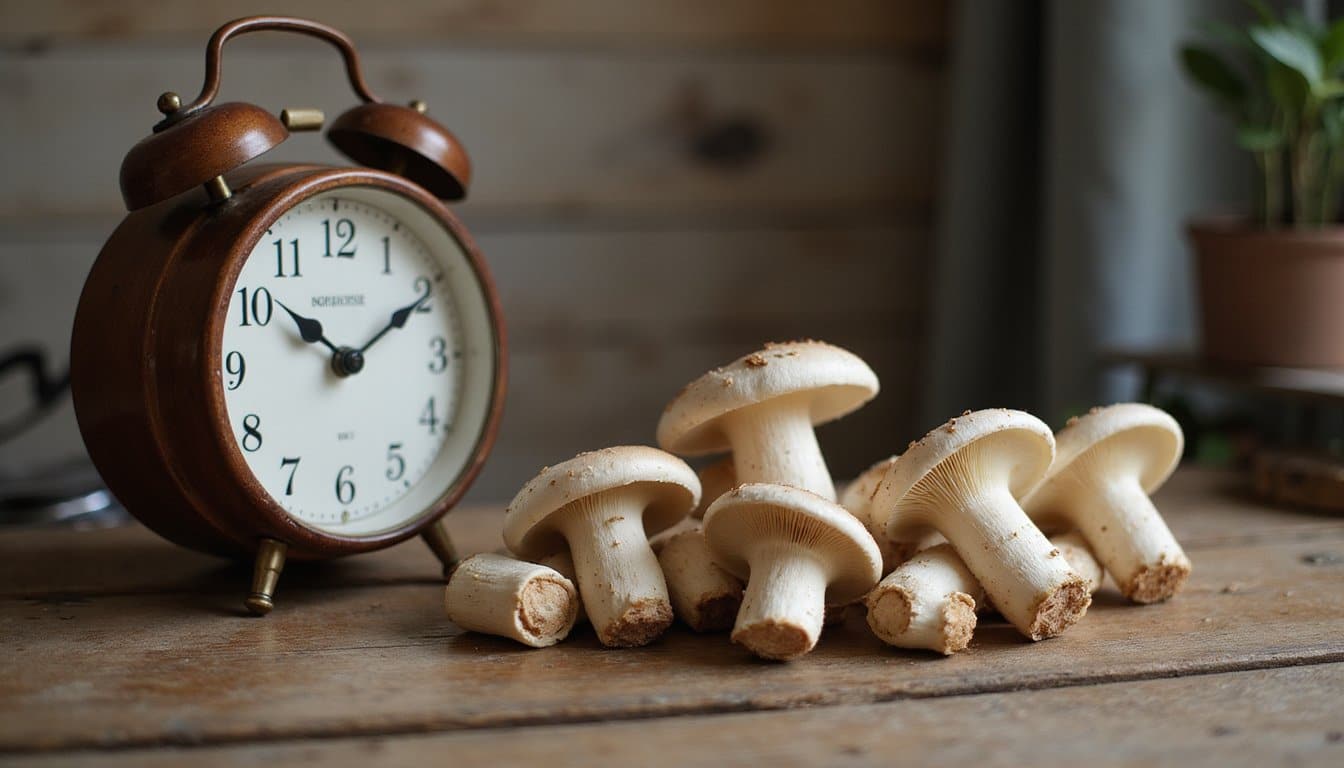
A psilocybin mushroom trip typically lasts 4 to 6 hours from first effects to full resolution. You’ll feel onset within 20 to 60 minutes, with peak intensity arriving between hours one and three and sustaining for 2 to 4 hours. Dosage, metabolism, stomach contents, and mushroom potency all influence your exact duration. Aftereffects like fatigue or mood shifts can persist 6 to 8 hours post-ingestion. Every variable shaping your experience is worth understanding before you go in.
When Do Shrooms Actually Kick In?
How quickly psilocybin mushrooms take effect depends on several measurable variables, though most people notice the first changes within 20 to 40 minutes of oral ingestion. On an empty stomach, onset accelerates to 20 to 30 minutes due to rapid gastrointestinal absorption. Consuming food beforehand extends this window to 60 to 120 minutes, with fatty or protein-heavy meals producing the longest delays.
Your metabolism, body composition, and age directly influence psilocybin duration by affecting hepatic conversion rates. Faster metabolism shortens onset to 15 to 20 minutes, while leaner body composition supports standard absorption timing. Mushroom tea reduces magic mushroom effects duration onset by 10 to 30 minutes compared to dried oral ingestion.
Understanding psychedelic duration time begins with recognizing that onset variability reflects individual physiology rather than inconsistent potency. Psilocybin itself is a prodrug that must be converted to psilocin in the body before any perceptible effects begin.
What You Feel at Each Stage of a Mushroom Trip
A psilocybin experience unfolds across five distinct phases, each carrying its own perceptual and emotional characteristics. Understanding what you’ll encounter at each stage helps contextualize the full psilocybin trip length, which typically spans 4, 8 hours.
| Phase | Duration | Key Effects |
|---|---|---|
| Onset | 20, 60 minutes | Tingling, mild visual distortions, euphoria or anxiety |
| Come-Up | 1, 2 hours | Intensifying visuals, vivid colors, emotional amplification |
| Peak | 1, 3 hours | Ego shifts, time distortion, deep introspection |
| Come-Down | 1, 2 hours | Tapering visuals, returning mental clarity, fatigue |
After the come-down, you may enter an afterglow phase marked by emotional relief or lingering reflection. Fatigue can persist into the following day. Dose and metabolism directly determine how long each phase lures you through its progression. This occurs because psilocybin is metabolized into psilocin, the compound ultimately responsible for producing the hallucinogenic effects you experience throughout each stage. After the come-down, you may enter an afterglow phase marked by emotional relief or lingering reflection, which often raises questions about how long does it take to recover from a mushroom trip, as fatigue can persist into the following day. Dose and metabolism directly determine how long each phase lures you through its progression. This occurs because psilocybin is metabolized into psilocin, the compound ultimately responsible for producing the hallucinogenic effects you experience throughout each stage.
How Long Does the Peak of a Shroom Trip Last?
Once psilocybin’s conversion to psilocin reaches its metabolic threshold, you’ll typically hit peak intensity between 90 minutes and 3 hours after ingestion, with most users reaching maximum effect around the 2-hour mark. The peak phase itself generally sustains for 2 to 3 hours, though higher doses can extend this window beyond 4 hours while lower doses compress it to as little as 1 hour. Your metabolism, stomach contents, mushroom potency, and body weight all directly influence both when you reach peak intensity and how long that intensity holds before tapering begins. During the peak, users commonly experience vivid visuals and deep introspection, along with an overwhelming sense of unity with the universe that can feel both euphoric and intense simultaneously.
Peak Timing and Duration
The peak phase of a psilocybin experience typically begins 1 to 3 hours after ingestion, with most users reaching maximum intensity around the 2 to 3 hour mark. Psilocybin pharmacology explains this timing: your body must first convert psilocybin into psilocin, which then binds to serotonin receptors and produces peak effects.
Once you reach peak intensity, it generally persists for 2 to 4 hours, during which visual distortions, cognitive alterations, and emotional changes hit their maximum. Dosage dramatically shapes this window, lower doses compress peak duration, while higher doses extend it through sustained psilocin concentrations.
Your metabolism, liver function, stomach contents, and mushroom potency all influence exactly when your peak arrives and how long it sustains before effects gradually diminish.
Intensity of Peak Effects
Reaching the peak marks the point where psilocin’s serotonergic activity hits its ceiling, and what you experience there is neurologically distinct from any earlier or later phase of the trip. Geometric visuals, color saturation, and perceptual warping all maximize between hours two and three. Emotional amplification, heightened sensory sensitivity, and ego dissolution correlate directly with peak psilocin plasma concentrations. At higher doses, exceeding three grams, boundary dissolution and introspective immersion intensify and sustain longer within that window. Temporal distortion also peaks here, making the phase feel subjectively extended despite its defined pharmacokinetic boundaries. Once intensity begins tapering, it does so unidirectionally, there’s no secondary return to peak hallucinogenic effects. The entire maximum-intensity window typically spans one to three hours depending on dose and individual metabolism.
Factors Affecting Peak Length
How long your peak actually lasts depends on a constellation of interacting variables rather than a fixed pharmacokinetic constant. Dosage remains the primary determinant, with typical amounts producing 2, 4 hour peaks, while higher doses slow metabolization and extend that window. Your body composition directly influences psilocybin distribution across tissues, altering elimination timing. Genetic polymorphisms in P450 enzymes further shift peak duration between 1, 4 hours individually.
| Factor | Effect on Peak Length |
|---|---|
| Higher dosage | Extends peak beyond 4 hours |
| Faster metabolism | Compresses peak to 1, 2 hours |
| Anxious mental state | Prolongs perceived peak intensity |
Recent psychedelic use introduces cross-tolerance, shortening your perceived peak despite equivalent dosing. Your psychological state also matters, anxiety extends challenging peak aspects, while preparation facilitates smoother 2, 3 hour resolution.
What Makes a Shroom Trip Last Longer or Shorter?
Several variables directly influence how long your mushroom trip lasts, including dosage, potency, metabolism, stomach contents, tolerance, and consumption method. Higher doses extend your experience, while a faster metabolism shortens it; consuming mushrooms on an empty stomach accelerates onset, whereas a full stomach delays absorption and lengthens the trip. If you’ve used psilocybin recently, your tolerance won’t necessarily shorten the duration, but it will reduce intensity, and your choice of preparation, such as lemon tea versus dried mushrooms, can dramatically/considerably/substantially alter how quickly effects begin and how long they persist.
Dosage and Potency
Among the most significant determinants of trip duration, dosage and potency directly shape how long psilocybin’s effects remain active in the body. Higher doses extend both peak intensity and total duration, while potency variations between strains affect onset timing and overall length. Psilocybin’s half-life averages three hours, meaning heavier doses sustain detectable effects considerably longer.
| Dose | Duration | Primary Effects |
|---|---|---|
| 1, 1.5g | 3, 4 hours | Mild visuals, euphoria |
| 1.75, 2.5g | 4, 6 hours | Open/closed-eye visuals |
| 3, 5g | 6, 8 hours | Ego dissolution, intense hallucinations |
Dried mushrooms concentrate psilocybin more than fresh material, effectively increasing your functional dose. Tolerance buildup shortens subsequent trips by weakening receptor response, while degraded mushrooms reduce potency, compressing overall duration.
Metabolism and Stomach Contents
Whether your trip runs four hours or eight often comes down to how efficiently your body processes psilocin. Your liver’s CYP2D6 and CYP3A4 enzymes drive primary metabolism, while MAO-A and UGT enzymes handle secondary breakdown. If you’re a poor CYP2D6 metabolizer due to genetic polymorphisms, you’ll clear psilocin more slowly, extending perceptual effects noticeably.
The psilocin half-life ranges from 1.5 to 4.8 hours depending on your administration route, liver function, BMI, and age. Oral ingestion produces a longer half-life than intravenous delivery. Stomach contents shift your onset by 30 to 90 minutes but don’t extend total duration, which remains 4 to 8 hours from onset. Concurrent SSRIs further complicate elimination by interacting directly with serotonin systems.
Tolerance and Consumption Method
How long your trip lasts isn’t fixed, tolerance and consumption method can push that window considerably shorter or narrower. Both variables directly influence mushroom trip duration and how long do shroom effects last in your system.
- Tolerance: Rapid tolerance development means repeated use requires higher doses to achieve equivalent effects, indirectly extending trip length and psilocin clearance time.
- Cross-tolerance: Exists among serotonin 2A receptor agonists, meaning prior psychedelic use affects your baseline sensitivity.
- Tea consumption: Accelerates absorption tremendously, producing onset within 5, 10 minutes versus 30 minutes for dried mushrooms eaten whole.
- Whole dried mushrooms: Extend metabolic processing time due to slower gastrointestinal breakdown, stretching the overall experience timeline.
Discontinuing use for one week resets tolerance to baseline, restoring standard dose-response thresholds.
Do Higher Doses Change How Long Shrooms Last?
Dose level directly shapes how long a psilocybin experience lasts. With low doses of 0.5, 1.5g of dried psilocybe cubensis, you’ll typically notice effects resolving within 3, 4 hours. Moderate doses of 1.5, 3g extend that window to 4, 6 hours, sustaining stronger introspection and visual intensity. At higher doses exceeding 3g, total duration stretches to 6, 8 hours due to prolonged psilocin plasma concentrations.
The pharmacokinetic mechanism is straightforward: larger amounts require longer clearance time. Psilocin carries an approximate half-life of 50 minutes, but higher doses maintain active plasma levels well beyond initial onset. Your peak phase also lengthens from roughly one hour at low doses to up to three hours at high doses. Dose, as a result, is the primary variable controlling overall trip duration.
How Long Do Shroom Aftereffects Last?

Once the acute psychoactive phase concludes, aftereffects can persist well beyond the 6, 8 hour primary window. Your body clears psilocybin compounds rapidly, roughly 66% excretes within the first three hours, yet psychological effects outlast biochemical clearance considerably.
Psilocybin clears your system fast, but the mind takes considerably longer to follow.
Common post-trip aftereffects include:
- Afterglow or fatigue setting in 6, 8 hours post-ingestion, sometimes extending into the following day
- Mood shifts, mental fog, or sleep disruption persisting hours to days after the acute phase
- Residual physical effects such as delayed headaches, exhaustion, or lingering nausea beyond the 6-hour mark
- HPPD, a rare disorder causing persistent visual disturbances with no established cure
Psychological aftereffects remain undetectable in standard drug screenings despite their duration, meaning physiological clearance does not indicate full neurological resolution.
Help Is One Call Away
If Psilocybin addiction is taking over your life, you don’t have to face it alone. At Vive Treatment Centers, we provide trusted Psilocybin Addiction Treatment and a flexible Intensive Outpatient Program (IOP) built to support your recovery every step of the way. Call (202) 506-3490 today and take the first step toward a healthier life.
Frequently Asked Questions
Can You Sleep During a Mushroom Trip to End It Faster?
You can’t sleep during a mushroom trip to end it faster. Psilocybin metabolizes independently of your sleep state, keeping the total duration fixed at 3, 6 hours regardless of rest attempts. During peak intensity (hours 1, 3), heightened arousal, nausea, and sensory distortions physiologically prevent sleep onset. Your body must fully metabolize psilocin before effects diminish. Sleep doesn’t accelerate psilocin clearance, only natural metabolic processing determines when the experience concludes.
Do Shroom Effects Last Longer the First Time You Try Them?
No, first-time use doesn’t inherently extend the 4 to 6-hour general duration. You’ll follow the same timeline as experienced users. However, your perception of time may feel dramatically distorted, making the experience *seem* longer. Additionally, you’re more likely to misinterpret onset sensations and experience anxiety during the initial 20 to 40-minute phase. The psychological impact can also persist for days beyond the physical effects, extending your overall subjective experience considerably.
How Long After Eating Shrooms Can You Safely Drive?
You shouldn’t drive until all psychoactive effects have completely cleared your system. Psilocybin typically produces effects lasting four to six hours, but impairment can persist beyond that window depending on your dose and metabolism. Even after peak effects subside, you may experience altered perception, impaired reaction time, and distorted spatial judgment. There’s no universally safe timeframe, so you should arrange alternative transportation, walking, cycling, or public transit, before consuming psilocybin mushrooms.
Does Drinking Water or Eating Speed up the End of Effects?
Neither drinking water nor eating will meaningfully speed up the end of your psilocybin effects. Food primarily delays onset rather than shortening total duration, which stays consistent at 4 to 8 hours regardless of what you consume. While hydration supports kidney function, and your kidneys excrete roughly 66% of psilocybin compounds within the first 3 hours, no research confirms that increased water intake accelerates the metabolic clearance of psilocin or noticeably reduces your trip’s duration.
Can Anxiety or Fear Make a Shroom Trip Feel Longer?
Yes, anxiety or fear can make your trip feel considerably longer. When you experience psychological distress during a psilocybin session, your heightened emotional state intensifies time distortion, a perceptual phenomenon already common during the peak phase. Your brain’s altered serotonin signaling amplifies threat-response mechanisms, making each moment feel stretched. This doesn’t extend the pharmacological duration, but it dramatically changes your subjective experience of time, making four hours feel vastly longer than it actually is.